
Putting It In Perspective
Birds GM Explains Roster Moves
PHILADELPHIA — On Monday afternoon, Eagles executive vice president/general manager Howie Roseman met with reporters for his annual post-roster cutdown press conference and to discuss the state of the Eagles headed into the 2026 season.
Among the topics were his insight into his thought process of carrying four quarterbacks, the appeal of a certain fourth tight end, and the decision to waive two international players.
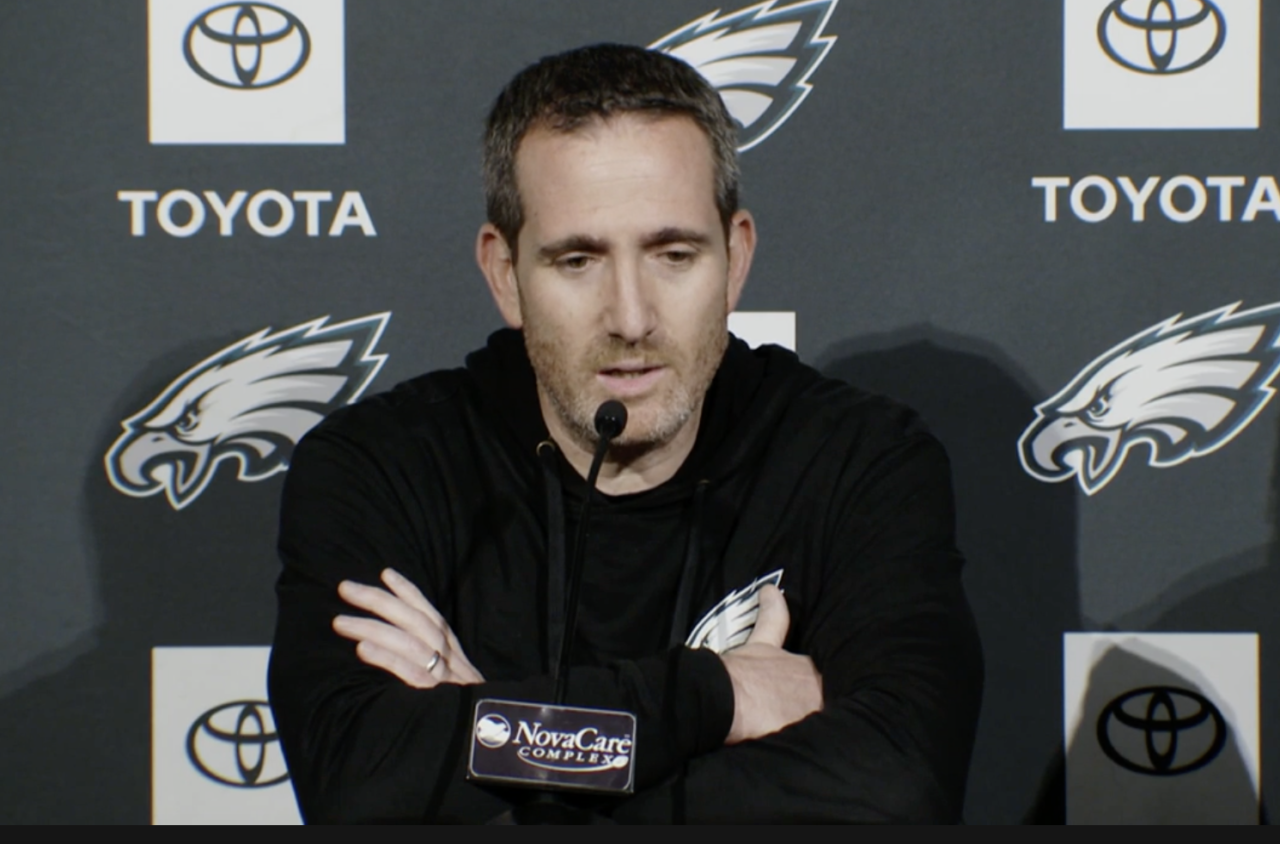
ITB PHOTO: Eagles EVP Howie Roseman explained some of his decisions in terms of 53-man roster strategy.
Here are a few takeaways from Roseman’s press conference.
QB quartet
The Eagles were among a handful of teams fielding an initial 53-man roster with four quarterbacks. The monthslong battle between fourth-year pro Tanner McKee and veteran Andy Dalton for the No. 2 job behind Jalen Hurts never resolved itself, with both signal callers equally uneven throughout training camp. Dalton, who has experience functioning in a similar system, naturally appeared more comfortable and a tick more decisive, but fell flat in the preseason games. He was more effective throwing short-to-intermediate, while his deeper throws lacked zip.
McKee, a 2023 draftee with plenty of internal supporters, pulled slightly ahead down the stretch, but also lacked consistency. It appeared the competition was all but wrapped up following his performance in the second preseason game against the Patriots, yet the Eagles continued to rotate the two quarterbacks.
In the aftermath of cutdowns, however, both remain on the roster. So too does rookie fifth-round pick Cole Payton, an uber-athletic developmental prospect in need of seasoning. While unconventional, all three backups, in theory, provide something unique to the roster.
McKee, for example, has shown flashes of upside with potential starting upside in the past. While that hasn’t yet proven true in this offense, perhaps more time in the system could help smooth things out.
Dalton, 38, has a resume that includes 169 career starts and has been exposed to various offensive systems. His experience could be a valuable asset, serving as a sounding board and extra set of eyes for the other quarterbacks in the room.
Then there’s Payton, who clearly has tools, and versatility, to work with. His roster spot represents a long-term vision. It’ll essentially be a redshirt year for the North Dakota State, but the Eagles are committed to his development.
With McKee and Dalton, it’s important to consider the full body of work, rather than reach a conclusion solely based on preseason performance. The Eagles weren’t going to simply move off of either for anything less than what they deemed to be appropriate compensation, as Roseman has seen firsthand the importance of having options at the backup quarterback position.
“It’s just such a valuable position,” Roseman said. “From our perspective, last year, obviously we took someone in the fifth round, let him go. He left our practice squad to go somewhere else, traded for a sixth-round pick. These guys are valuable. They take time to develop at the same time. That position is so valuable to this organization over a long period of time. [We] want to be strong there and think both those guys behind [QB] Jalen [Hurts] have value, have shown that over the course of their careers. We kind of take all the information at our disposal to make all these decisions.”

For the first time, Eagles TE E.J. Jenkins made the 53 coming out of camp.
A Surprise at Tight End
That the Eagles held onto four tight ends on the 53-man roster wasn’t much of a surprise, as the offense under first-year coordinator Sean Mannion is likely to involve heavy positional usage. But the fourth tight end, at least on the initial version of the roster, was widely expected to be fourth-year pro Cam Latu.
Latu, 26, was a special teams stalwart for the Eagles last season, racking up 10 tackles and a forced fumble. He also moonlighted as a fullback, showcasing a desire for playing with reckless abandon. He seemingly craves contact.
Latu, however, was waived and later claimed by the New England Patriots as the Eagles instead decided to keep another fourth-year pro in E.J. Jenkins.
From a receiving standpoint, Jenkins, 27, had a relatively quiet camp. Where Jenkins excelled was in the blocking department, where he served as a punishing inline blocker and thrived in pass protection. Perhaps best illustrating his understated impact in that regard was on a particular rep in the first joint practice with the Patriots.
Jalen Hurts dropped back, scanning the field, as Patriots cornerback Marcus Jones stormed around the corner. Jenkins picked up Jones, enabling Hurts to stay in the pocket and deliver a deep strike to wide receiver Elijah Moore for a touchdown. Later in the session, Jenkins tossed another defender – another defensive back – aside in pass protection.
In the preseason games, if you were paying attention, you saw Jenkins control his defender and impose his will in the run game, driving them backward. Not exactly a skill that’s reflected in a box score, but a trait that proves extremely valuable within the context of the Eagles’ offense.
The 6-foot-6, 260-pound Jenkins – a former collegiate wide receiver – made notable strides in his blocking prowess the past two seasons, spending time working with then-tight ends coach Jason Michael and picking the brain of teammate Dallas Goedert. It’s something he’s taken a lot of pride in.
He’s been on and off the roster during his Eagles’ tenure – even appearing in Super Bowl LIX – but on Sunday, Jenkins made the 53-man roster out of training camp for the first time.
“E.J. is a great story,” Roseman said. “When you talk about a receiver at Georgia Tech who transformed his body, he’s 260 pounds, he’s 6-6, he’s got 34-inch arms. You see in this league where the position is going, where it’s trending. A lot of similar offensive systems to some of the things that we’re running where these wide tight ends, they’re highly valued in free agency, they’re highly valued in the draft.
“For us to be able to develop E.J. and his skillset, which as a former receiver has really not only turned to, obviously he’s a big target in the passing game, but a point of attack player. His pass protection – when we went over his pass protection – it is really, really good to have a tight end who’s able to pass protect like he is and then in the run game be able to help.
“It’s just being highly valued, and he contributed on special teams. Just E.J.’s body of work over time, sometimes you forget he played for us in the Super Bowl in 2024, but great developmental story for our organization, for the people who develop players, and really just excited about the role that he can have on this football team.”
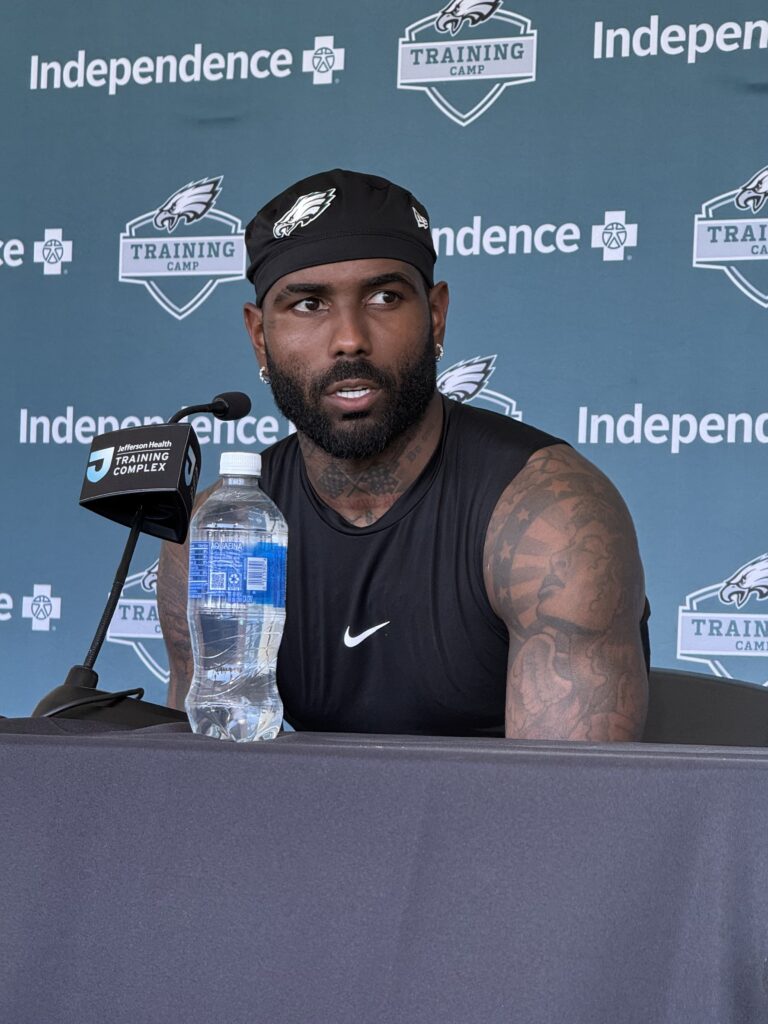
ITB PHOTO/ANDREW DICECCO: Veteran WR Elijah Moore made the 53 after a great camp, but his role is uncertain.
Production Rewarded
One of the toughest omissions when piecing together my final 53-man roster was Elijah Moore. He flashed most every practice, demonstrating consistency and veteran savvy, while becoming a trusted target for Hurts. Moore’s quickness in and out of breaks and surehandedness made him a popular intermediate target, but he also had moments when he stretched the secondary.
Moore would have been a tough cut, to be sure, but Moore is a vested veteran who had split time last season between two practice squads. At first glance, an inclusion of Moore felt more like a luxury than a necessity.
But after zooming out a bit, Moore’s role, at least in the early going, becomes clearer. Makai Lemon, selected in the first round this spring, missed a large chunk of training camp with a hamstring injury, steepening his learning curve upon his return. While the Eagles will most certainly find ways to get Lemon the football, the team now has another option in Moore to lessen the burden for Lemon in the event of growing pains. Moore functions similarly in this offense and can absorb some snaps if need be.
There’s also the vested veteran part, which could have actually worked against the Eagles if the two sides parted ways. Sure, the Eagles could have offered Moore a spot on the practice squad. But there’s also number of receiving corps light on depth and experience who might’ve welcomed Moore, presenting him with a more clearly defined role.
By keeping him, they’ve eliminated the possibility of him being courted elsewhere.
Above all, though, the Eagles didn’t overthink this roster decision. Moore did his part, and Roseman rewarded a veteran player who maximized an opportunity to revitalize his career.
“Elijah Moore had a great camp,” he said. “He was able to separate. He knows how to get open. He catches everything. This is a guy that we really liked coming out of Mississippi. [Senior Vice President, Player Personnel] Joe [Douglas] drafted him with the Jets. When he traded him to Cleveland, we were interested in him at that time, followed him.
“Didn’t really have the end of last year that he wanted to in Buffalo and Denver. We came in and just said there’s going to be an opportunity. He came in in great shape. All he did was really make plays. We know that if we put him in the game, we can count on him to run good routes, to separate and catch balls. We didn’t want to risk losing that.”
— Andrew DiCecco (@AndrewDiCecco) is a Staff Reporter/Content Producer for InsideTheBirds.com.
About The Author




Comments are closed here.